The Evidence Guide Your Assessor Won't Give You
A control-family-by-control-family reference mapping all 110 practices to the evidence artifacts C3PAO assessors commonly request — and what separates a pass from a finding.
Download the Free Evidence Guide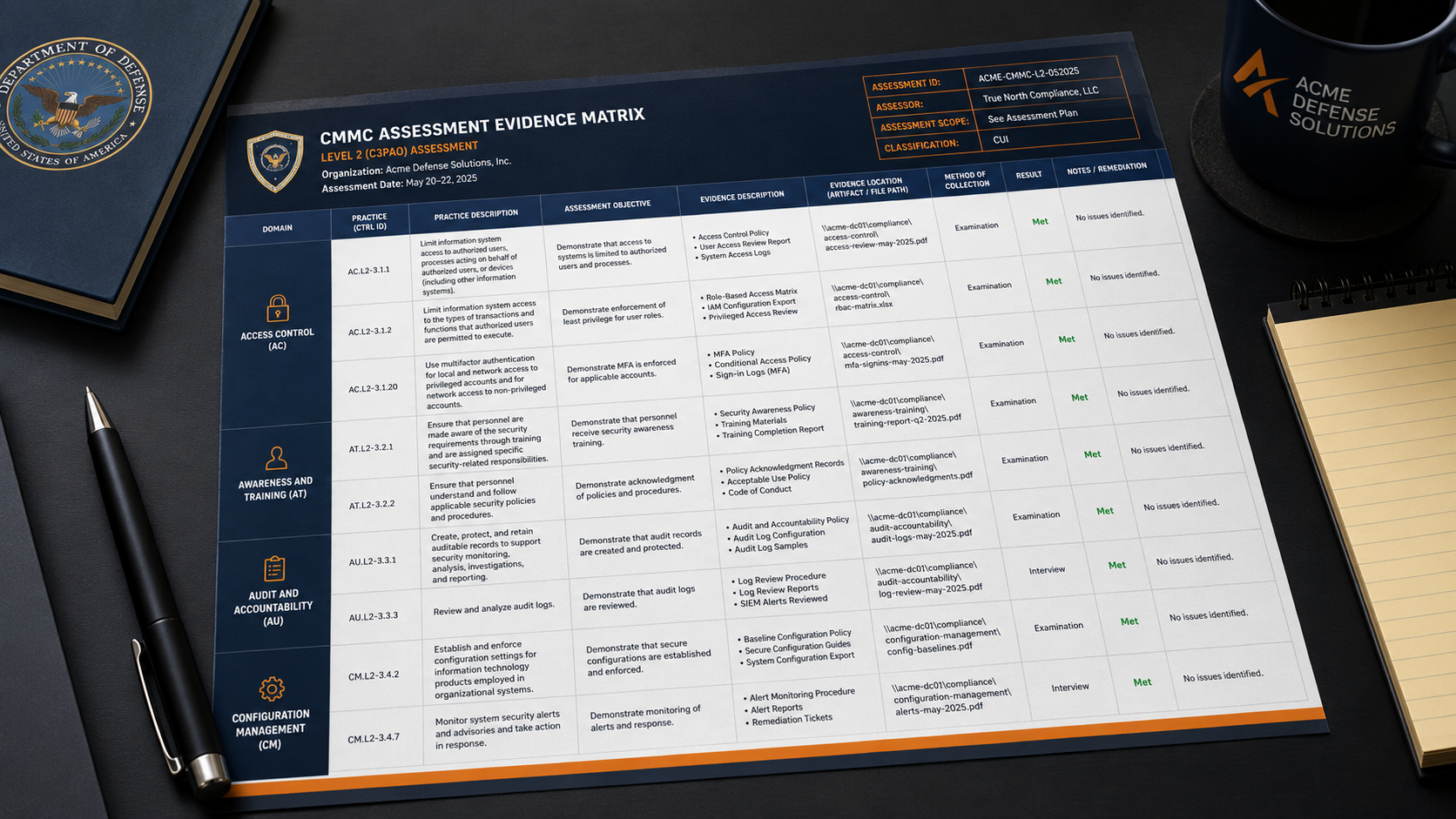
How a C3PAO Assessor Evaluates Your Environment
The CMMC assessment is a structured verification process — not a paperwork audit, not a penetration test. Here is what every contractor preparing for Level 2 needs to understand.
The Three Assessment Methods
Examine, Interview, and Test — how each method works, what assessors are looking for, and why inconsistency between them produces findings.
High-Scrutiny Control Families
Why AC, AU, CM, IA, and SC generate the most findings — and the specific technical and documentary evidence assessors require for each.
What Turns a Control into a Finding
The five patterns that cause implemented controls to fail assessment — SSP currency, evidence consistency, interview alignment, scope definition, and POA&M limits.
MET vs. NOT MET Determinations
How assessors make practice determinations, which findings are deferrable through a POA&M, and which require immediate remediation before certification is granted.
Assessment Boundary Validation
How scope is defined, why boundary ambiguity invites expansion, and what your network architecture documentation must clearly demonstrate to protect the boundary.
Personnel Interview Preparation
Why interview inconsistency is a reliability signal that calls all your evidence into question — and how to ensure your technical staff can accurately describe what is implemented.
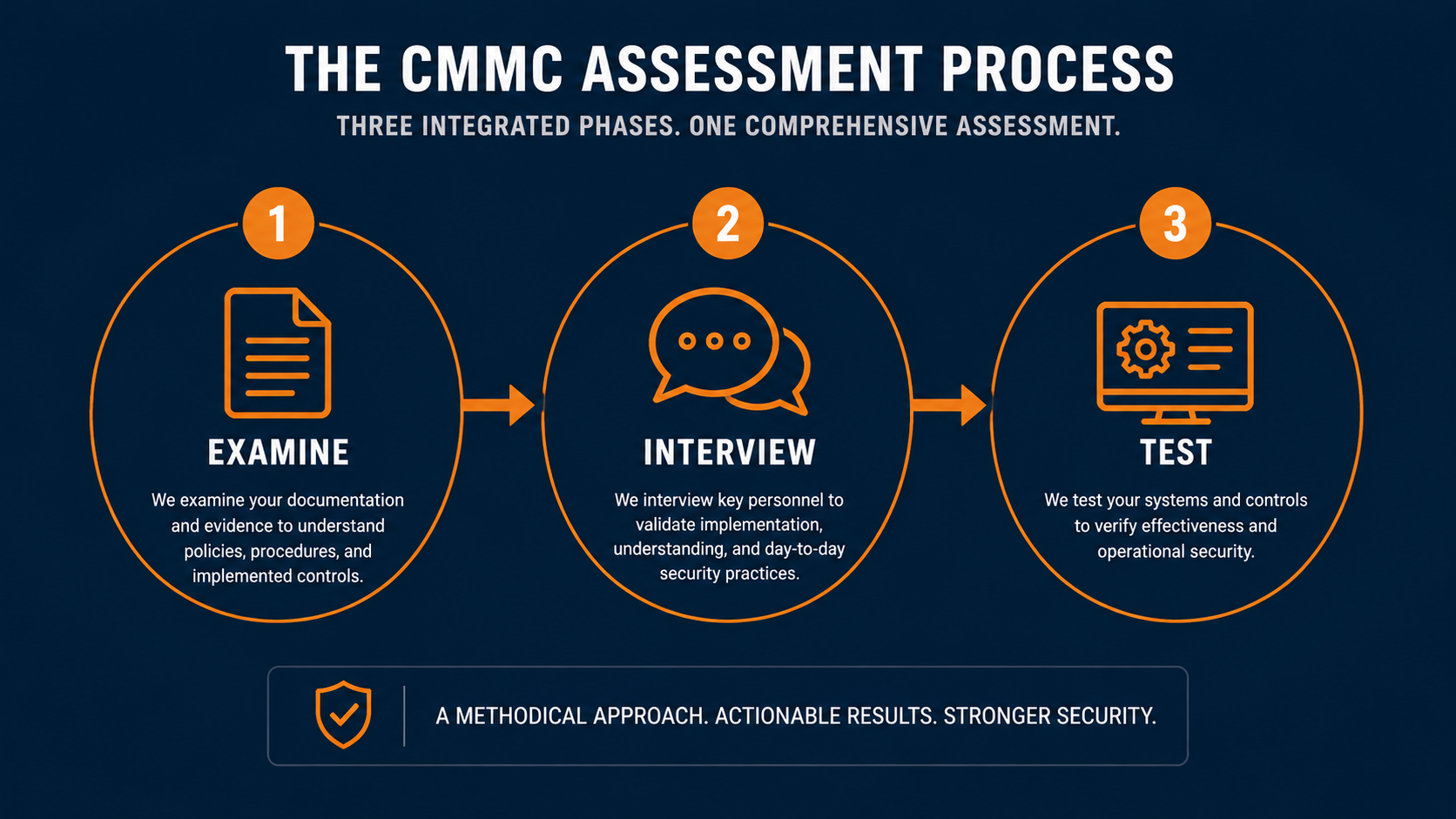
Three Methods. One Coherent Picture.
Every practice in the CMMC Assessment Process is evaluated through one or more of these methods. If one produces an inconsistency, it calls the others into question.
Method 01
Examine
The assessor reviews documentation — your SSP, policies, procedures, configuration baselines, network diagrams, asset inventories, audit logs, and training records. The document must reflect current state, not planned state.
Method 02
Interview
The assessor speaks with your system administrators, security staff, and end users. They verify that the people responsible for implementing controls understand what is deployed and why. Inconsistency with your SSP is a finding.
Method 03
Test
The assessor observes or interacts with the system directly — firewall rules, MFA in practice, audit log samples, endpoint configurations, access control lists. Controls must be operational, not just documented.
Common Assessment Failures
Implemented Controls That Still Produce Findings
Most contractors fail not because controls are unimplemented — but because the assessor could not confirm they were. These are the patterns that cause ready organizations to generate findings.
Get the Evidence Reference Guide-
1SSP Describes a Future State
The assessor examines the SSP and then tests the system — when they do not match, that inconsistency is a finding even if the technical implementation is correct.
-
2Evidence Assembled Only for the Assessment
Assessors can tell when audit logs were activated the week before. Evidence that only exists for the assessment will not hold up under interview and test scrutiny.
-
3Interview Inconsistency
When documentation says one thing and your system administrator describes a different process, assessors treat it as a reliability signal that calls all your evidence into question.
-
4Ambiguous Assessment Boundary
If out-of-scope systems have network connectivity to CUI-bearing systems and are not properly isolated and documented, the assessor may expand scope.
-
5Treating POA&Ms as a Free Pass
Not all findings are deferrable. Certain practices require immediate remediation before certification is granted — and the aggregate of deferred findings can prevent certification entirely.
The Control Families Assessors Focus On
These families generate the most findings because they require both technical implementation and operational evidence. The guide maps every practice in each family to its evidence artifacts.
What's Inside
The CMMC Level 2 Assessment Evidence Guide
A practitioner-written reference built for IT managers, security managers, compliance leads, and consultants preparing for a CMMC Level 2 assessment — or preparing a client for one.
-
Control-family-by-control-family breakdown
Organized by NIST SP 800-171 domain so you can work through each area systematically before the assessment.
-
Evidence artifacts mapped to each practice
For all 110 practices, the specific documentary, interview, and technical evidence assessors commonly request.
-
MET/NOT MET decision criteria
What constitutes sufficient and consistent evidence for a practice determination under the CAP framework.
-
Pre-assessment readiness checklist
Six concrete steps to validate SSP currency, evidence integrity, boundary documentation, and personnel readiness before the formal assessment begins.
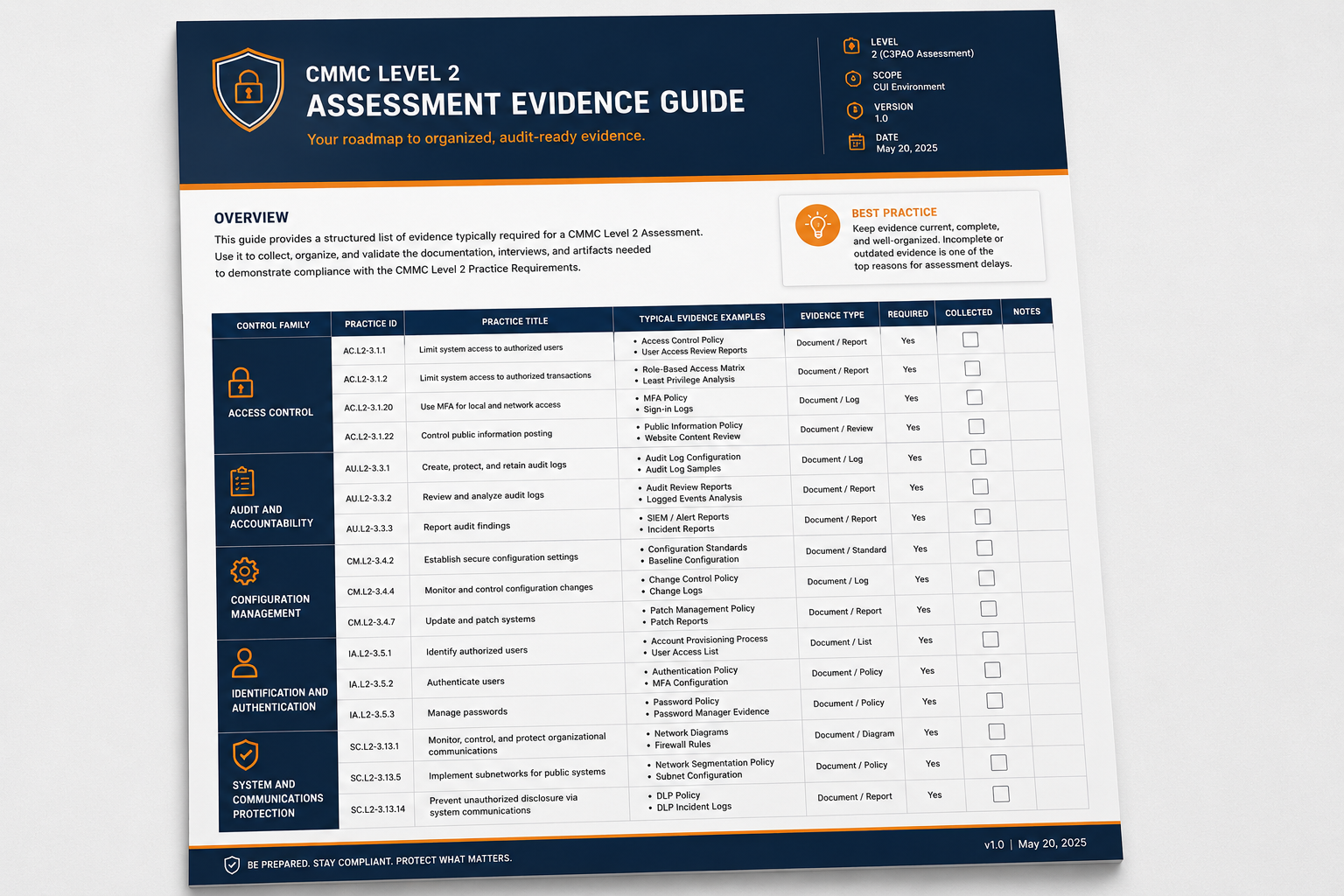
Get the Assessment Evidence Guide
Know what the assessor is looking for before they walk in the door. Enter your information below and we will send the guide directly to your inbox.
Request Your Free Copy
Complete the form below to receive the CMMC Level 2 Assessment Evidence Guide — a control-family-by-control-family reference for practitioners preparing for a C3PAO assessment.

CMMC Compliance Consulting for Defense Contractors
Xact Cybersecurity is a managed IT and CMMC compliance consulting firm based in Marlton, NJ. We work with defense contractors and small-to-mid-size businesses operating under DFARS 252.204-7012 — providing the technical and procedural preparation required to achieve and maintain CMMC Level 2 certification.
Start Your Assessment Preparation