Building a Change Management Process for CMMC Compliance
Many contractors understand that compliance does not remain stable on its own.
Policies age. Responsibilities shift. Systems change. Approval paths evolve. What was aligned six months ago may no longer reflect how the environment actually operates today.
The problem is that many organizations respond to these changes informally.
A requirement update is discussed in a meeting. A system change is handled operationally. A policy issue is noticed and flagged for later. Over time, these adjustments accumulate without a consistent process for reviewing what changed, determining what it affects, and ensuring the right follow-through occurs.
That is where compliance change management becomes essential.
A change management process for compliance is not just about tracking external updates. It is about creating a structured way to review anything that may affect control ownership, policy alignment, evidence continuity, or governance structure.
Organizations that build this process well are better able to stay aligned as requirements and environments evolve. Organizations that handle change informally often create the very drift they later struggle to explain.
This is not because they ignored compliance. It is because they never created a repeatable process for responding to change.
Why Compliance Change Management Matters
In operational environments, change is normal.
New technologies are introduced. Teams shift responsibilities. Internal workflows change. Contract expectations evolve. Guidance becomes more specific. Sometimes these changes are external. Often they are internal.
What matters is not simply whether change occurs. What matters is whether the organization has a way to evaluate the compliance impact of that change.
Without a defined process, change is handled inconsistently.
Some updates are reviewed in detail. Others are treated casually. Some are documented. Others remain informal. Responsibility for evaluating impact may shift from one person to another depending on availability rather than role.
That inconsistency creates several predictable problems:
policies no longer reflect current operations
review cadence becomes harder to enforce
evidence practices vary across teams
ownership gaps emerge quietly
decisions about what required action are lost over time
A formal change management process prevents these issues by bringing structure to how compliance-impacting change is identified, reviewed, assigned, and completed.
What Counts as a Compliance Change
One of the reasons organizations struggle with change management is that they define change too narrowly.
They often think only in terms of major regulatory announcements or formal requirement updates. In practice, compliance-impacting changes are broader than that.
Examples include:
updated guidance or interpretations
new system deployments
changes in control ownership or staffing
revised approval workflows
new vendors or cloud services
updated evidence retention practices
modified review cadence
shifts in scope or boundary assumptions
recurring trends identified during assessment preparation
Some of these changes originate outside the organization. Others come from the organization itself.
Mature contractors treat both types seriously because both can affect whether controls remain aligned over time.
Why Informal Review Fails
A common pattern in many compliance environments is informal review.
Someone notices a change. They mention it to a colleague. A team lead decides it probably does or does not matter. A small adjustment is made. Then attention moves elsewhere.
This approach creates awareness, but not governance.
The issue is not that no one thought about the change. The issue is that there is no durable record of:
what changed
who reviewed it
what part of the compliance model it affected
what decision was made
who was responsible for follow-through
whether the action was completed
Without those elements, continuity is lost.
Months later, the organization may remember that something changed, but not how it was reviewed or what was actually done in response. This is how the same issues get revisited repeatedly and why compliance maintenance becomes more exhausting than it needs to be.
What a Good Compliance Change Management Process Includes
A mature process does not have to be complicated, but it does need to be consistent.
There are five core components that matter.
1. Change Identification
The organization needs a reliable way to capture potentially relevant changes as they occur.
This may come from:
compliance review meetings
legal or contract review
internal architecture or operations changes
security review
leadership decisions
lessons learned from readiness work
The key is that changes are captured, not just noticed.
2. Initial Relevance Review
Not every change requires action.
The organization should assess whether the change affects:
policy
control ownership
workflow
review cadence
evidence handling
governance structure
This prevents both overreaction and neglect.
3. Assigned Review Ownership
A specific role should be responsible for reviewing and determining impact. If ownership is unclear, changes stall or move unevenly.
This ownership should be role-based, not informal.
4. Documented Decision
If the review concludes:
no action is required
policy updates are required
ownership should change
workflow adjustments are needed
evidence expectations should be revised
that decision should be documented.
This creates traceability and allows teams to understand what was decided later.
5. Action Tracking
If a change requires follow-through, someone must own implementation and there should be a way to see whether the action was completed.
This is what turns change review into operational governance.
A Practical Change Workflow
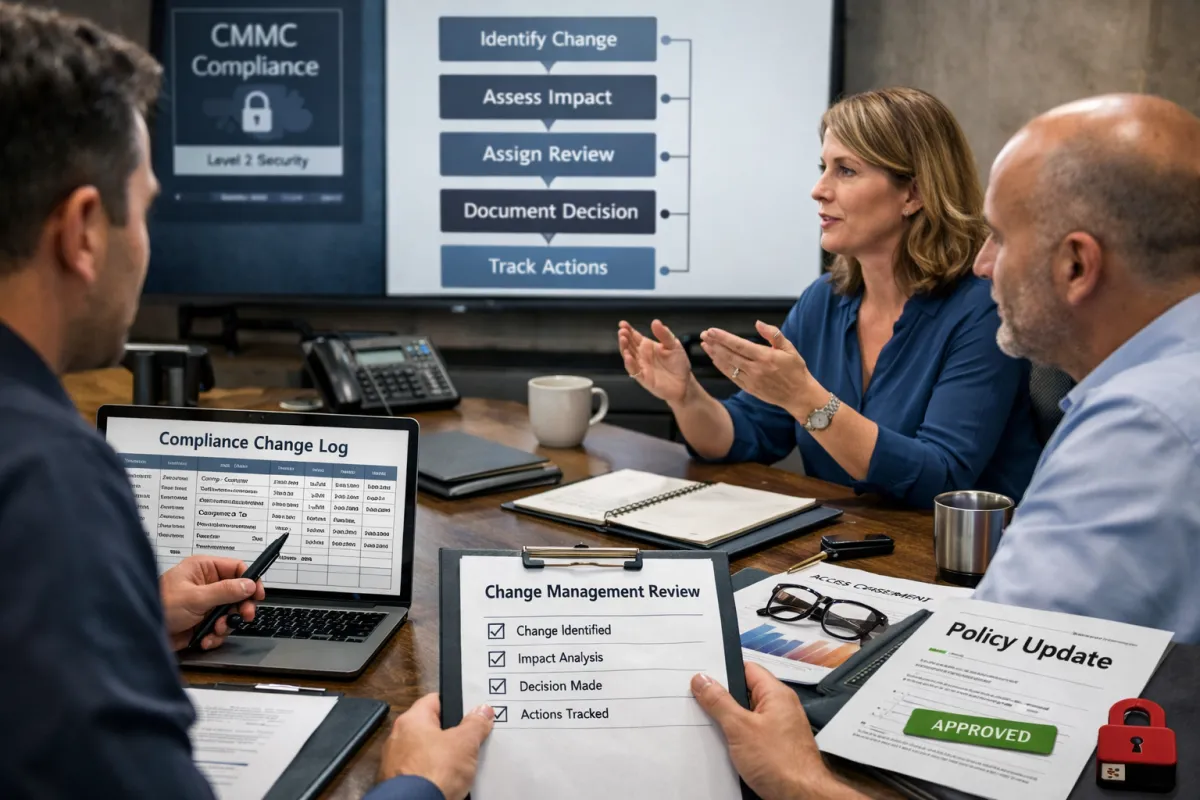
In most organizations, a workable process can be built around a simple sequence:
identify the change
log the update
determine relevance
assign reviewer
document impact
assign action owner
track completion
That process can be maintained through a Compliance Change Log or similar governance tracker.
What matters most is that the process is visible and repeatable.
Without that, every compliance-related change becomes a judgment call handled in isolation.
Where This Process Connects to CMMC
For Level 2 contractors, this matters because many control families rely on recurring alignment between documentation, ownership, and execution.
A change management process supports that alignment across areas such as:
Access Control (AC)
Changes in systems, applications, or approval chains may affect who owns access reviews, how approvals occur, or how evidence should be retained.
Audit and Accountability (AU)
Changes in logging tools, workflows, or responsibility models may alter how review is performed and documented.
Configuration Management (CM)
Operational changes often affect approval chains, baselines, and documentation practices, all of which need governance review.
Risk Assessment (RA) and System and Information Integrity (SI)
Updates to remediation workflow, prioritization methods, or evidence handling can create misalignment if not reviewed systematically.
This is why change management is not just a general governance function. It is directly tied to whether CMMC controls remain defensible over time.
A Common Failure Pattern
A contractor introduces a new SaaS platform into the environment.
The implementation is handled responsibly from an operational standpoint. Access is configured. Logging is enabled. Users are onboarded.
However, no one formally reviews what the change means for:
access approval policy
evidence location
ownership of recurring review
documentation of role assignments
existing scope assumptions
Months later, the platform is part of daily operations, but the governance structure has not caught up.
The issue is not that the system was added incorrectly. The issue is that the change was never processed through a compliance lens.
A defined change management process would have captured that early and assigned the necessary updates.
Why This Reduces Compliance Fatigue
When organizations lack change structure, they often revisit the same problems multiple times.
Policies become misaligned. Evidence models drift. Review owners change quietly. Then during readiness review or assessment preparation, teams are forced to reconstruct what changed and why.
That is exhausting.
A structured change process reduces that burden because:
decisions are logged once
ownership is clear
follow-through is visible
the organization can see whether updates were actually implemented
Instead of rediscovering problems later, teams address them earlier and with less friction.
That is one of the main benefits of process maturity.
What Mature Organizations Do Differently
Mature organizations do not wait for disruption before they review change.
They treat compliance-impacting change as part of routine governance.
That means:
internal changes are reviewed through a compliance lens
policy drift is treated as a governance issue, not just a documentation issue
ownership for change review is defined
evidence of decisions is retained
changes are tracked through completion
This is what allows compliance to remain aligned even when the environment is evolving.
They do not just sustain controls.
They sustain the organization’s ability to adapt those controls deliberately.
Conclusion
Building a change management process for compliance is one of the clearest signs that an organization has moved beyond one-time readiness thinking.
It means the team is not simply hoping its compliance structure stays aligned as things change. It has built a way to see change, evaluate impact, assign accountability, and follow through consistently.
That is what keeps compliance from becoming reactive.
It is also what makes governance sustainable.
For contractors operating in evolving CMMC environments, the issue is not whether change will happen. The issue is whether the organization is structured to respond without confusion, drift, or repeated rebuild effort.
A good change management process makes that possible.
CTA
To help organizations track compliance-related changes in a more structured way, we created a practical resource:
Compliance Change Log Template
This template helps teams document what changed, who reviewed it, whether internal action is required, and how follow-through is tracked.
Download the template to build a more repeatable process for responding to compliance-related change.


