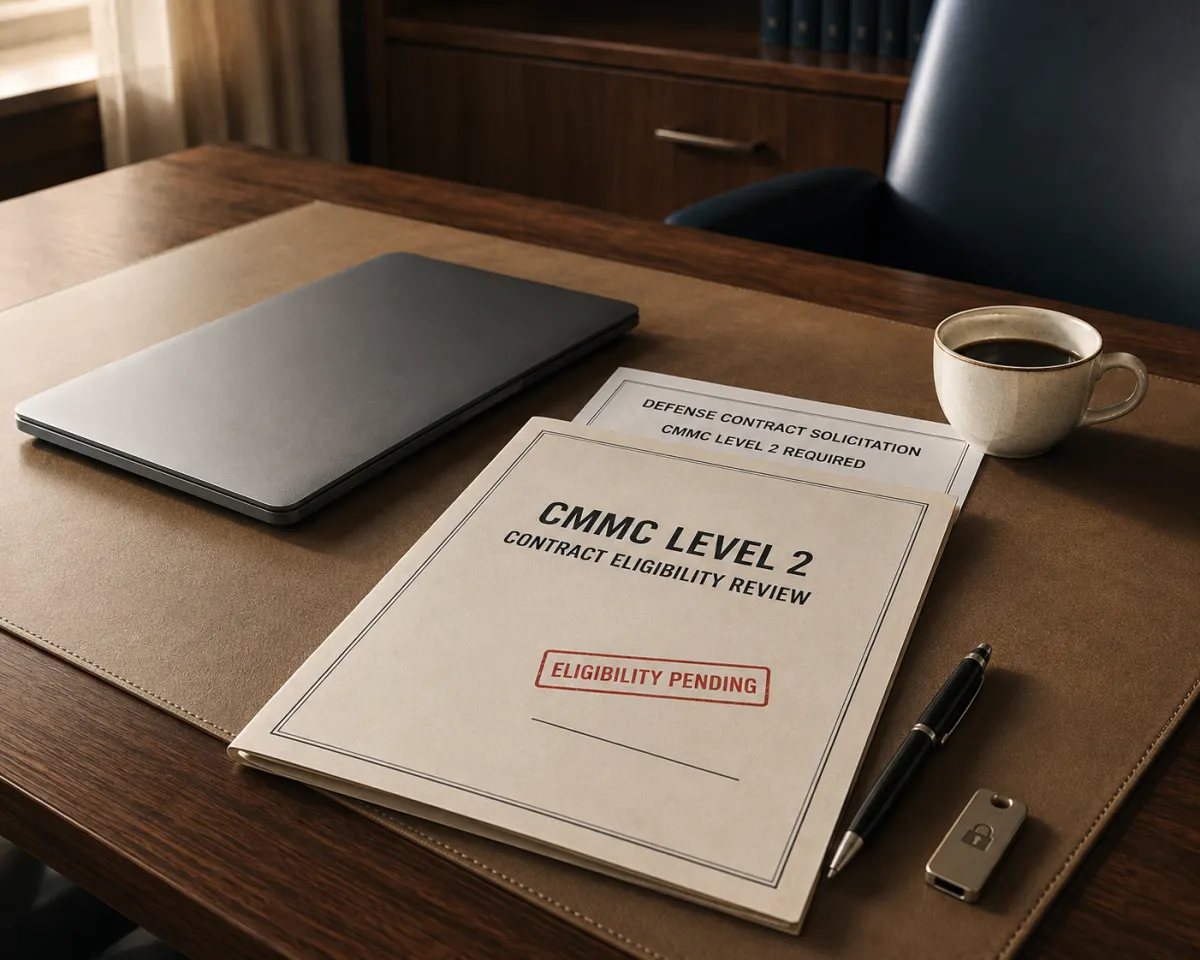
CMMC Is Not an IT Project — It's a Contract Eligibility Decision for Leadership
If your company cannot demonstrate CMMC compliance, you cannot bid on certain DoD contracts. Not "won't." Cannot. Your IT team may have purchased the right tools. Your compliance lead may have built a thorough spreadsheet. But if leadership has not made the decisions that CMMC actually requires, none of that activity protects your contract eligibility.
That gap between compliance activity and actual compliance is where defense contractors lose work, and it is rarely a technical failure. It is a leadership gap. This post is for business owners and executives at defense contractors: the people who fund compliance programs, sign off on risk decisions, and are ultimately responsible for keeping the company in the DoD supply chain.
The core question is simple. Does your leadership team understand that CMMC is not a paperwork project? How you answer that question determines whether CMMC becomes a competitive advantage or a contract eligibility crisis.
What CMMC Actually Requires
CMMC, the Cybersecurity Maturity Model Certification, is the Department of Defense's framework for ensuring that defense contractors adequately protect controlled unclassified information, or CUI. That information lives in your email, your file servers, and your project management tools. If your company works on defense contracts, you almost certainly handle it, whether or not anyone in your organization has labeled it that way.
CMMC Level 2, which applies to most defense contractors handling CUI, is built on the security practices defined in NIST Special Publication 800-171. Think of NIST 800-171 as the baseline rule book for protecting controlled information on non-federal systems. To achieve CMMC Level 2 certification, your organization must demonstrate to a certified third-party assessor that your security practices actually meet those requirements. Not that you plan to meet them. Not that you have a document stating you meet them. That you meet them, and that you can prove it.
Four business realities underlie that requirement, and each has direct consequences for ownership.
First, this is a verified certification, not a self-assessment. For most contractors, a Certified Third-Party Assessment Organization (C3PAO) evaluates your environment directly. You cannot pass that assessment with paperwork that does not reflect your actual practices. An assessor is not grading your intentions. They are testing your reality against your documentation, and the two need to match.
Second, CMMC requires a System Security Plan, or SSP, a document describing exactly how your organization implements each required security control. An assessor uses your SSP as the roadmap for what to test. If the SSP describes a security posture your organization has not actually built, that mismatch becomes the finding, not the gap itself.
Third, gaps between where you are and where you need to be must be tracked in a Plan of Action and Milestones, or POA&M. This document shows what remains unfixed and when you plan to fix it. Assessors review POA&Ms closely. They are not a place to park problems indefinitely, and a POA&M with no credible funding or timeline behind it tells an assessor exactly what they need to know about how seriously leadership is treating remediation.
Fourth, and this is the point most executive teams miss, CMMC is not a one-time event. Certification must be maintained. Your environment changes. People change. Systems change. If your security posture drifts after certification, you are exposed, and the next assessment or spot check will surface that drift.
From a business owner's perspective, CMMC readiness requires capital allocation, executive decisions about which systems are in scope, and ongoing operational discipline. It is not something that happens below you. It requires you.
What's Actually at Stake
The Department of Defense is embedding CMMC requirements directly into contract solicitations. If a solicitation requires CMMC Level 2 certification and your company is not certified, you cannot be awarded that contract. You cannot even serve as a subcontractor on it.
For companies that derive most of their revenue from defense work, that is an existential risk, not a regulatory inconvenience. For companies where defense work is a portion of overall revenue, losing DoD contracts can still trigger cash flow problems, workforce reductions, and downstream reputational damage across the defense market. Prime contractors and teaming partners talk. A lost contract due to certification gaps does not stay contained to a single bid.
The direction of travel is toward more enforcement, not less. Leadership at defense contractors needs to treat CMMC readiness the way they treat bonding capacity, insurance coverage, or financial audits: as a condition of doing business, not a discretionary IT initiative.
Why This Requires Ownership, Not Delegation
The decisions that determine CMMC outcomes are business decisions dressed up as technical ones. Which systems handle controlled information? Which employees need access to it? What does your cloud and IT architecture actually look like, and what are you willing to spend to align it? Those are ownership-level questions. An IT team cannot answer them on your behalf, because CMMC does not live only in technology. It covers policies, procedures, personnel, physical security, and incident response, all of which require decisions only leadership is positioned to make.
When executives disengage from these decisions, IT makes policy by default. Those default decisions may not reflect what the business can actually sustain operationally, and they may not reflect what an assessor expects to see. A technically competent IT team, left without executive input, will optimize for what is achievable rather than what is required, and the difference between those two things is exactly where assessment findings come from.
If you have delegated all of these decisions without understanding the stakes, your compliance program may be built on assumptions no one in your organization has actually verified.
Where This Leaves You
CMMC is not a compliance checkbox. It is a contract eligibility requirement and a business continuity issue that leadership must own directly. The organizations that get this right are not necessarily the ones with the biggest IT budgets. They are the ones where ownership made the decisions that only ownership can make: what is in scope, what remediation will cost, who inside the company is accountable, and whether the timeline actually works against upcoming solicitations.
If you are in the defense supply chain, the question is not whether CMMC affects your business. The question is whether your organization is ready when it counts, and whether leadership can answer that question with confidence today.
Get the Full Picture Before You Spend a Dollar
Before any remediation budget gets approved or any assessment gets scheduled, leadership needs a clear, honest picture of where the organization actually stands. The CMMC Business Risk Assessment Guide for Defense Contractor Executives walks through the questions every owner should be able to answer before committing time or money to a compliance path. It is built for the people who fund and are accountable for CMMC readiness, not for the IT team executing it.


