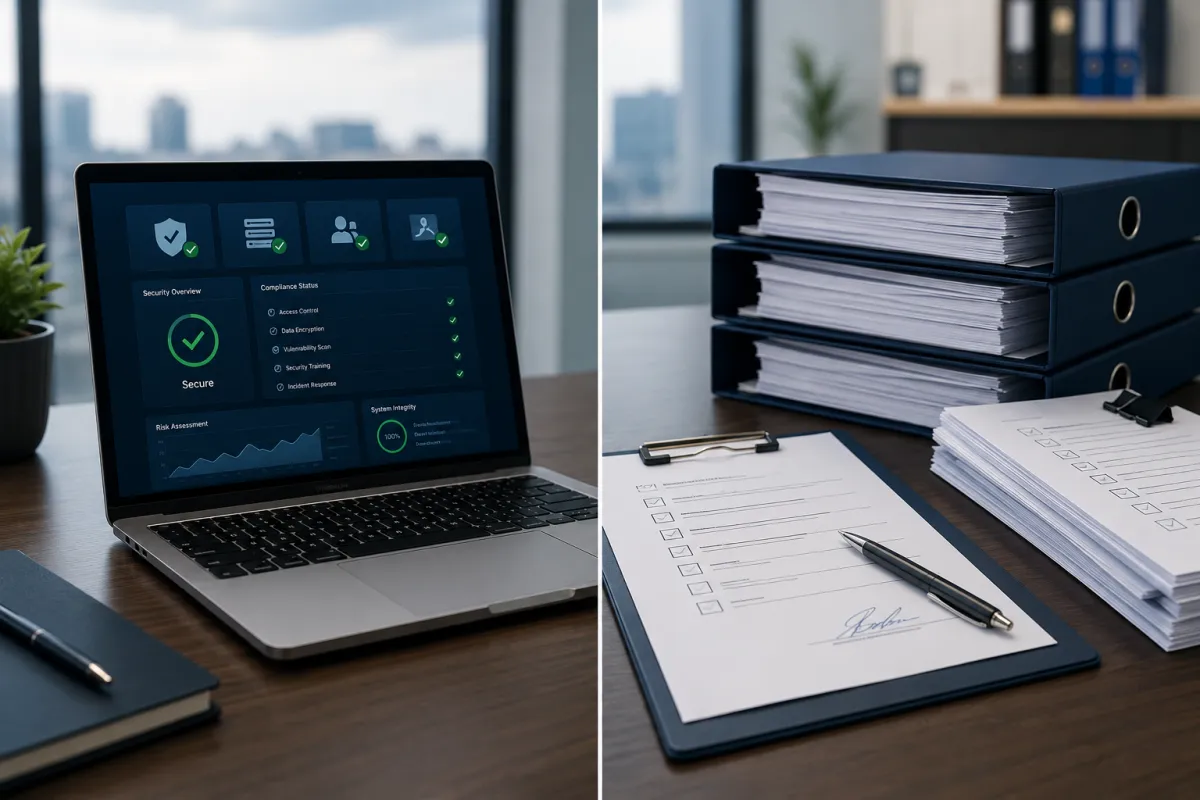
CMMC Progress Is Not the Same as CMMC Readiness. Here Is the Difference.
Most defense contractors we talk to right now are not ignoring CMMC. They are working on it. They have someone managing their IT environment, policies in place, tools deployed, and a general sense that things are moving in the right direction.
The problem is that working on it and being ready for a third-party assessment are two very different things. That gap between compliance progress and assessment readiness is exactly where most findings show up, and most organizations do not discover it until an assessor is already in the room.
Being in process means work is being done. Assessment readiness means that work is documented, attributable, consistent over time, and defensible to a third party who has no prior knowledge of your environment.
What the distinction actually means in practice
Progress is about activity. You are configuring controls, writing policies, deploying security tools, and training staff. These are all meaningful steps, and they matter. But progress is internal. It reflects what you believe is happening in your environment.
Readiness is about evidence. It answers a different question entirely: if a third party walked in today with no prior knowledge of your program, could they verify that every required control is implemented, consistently applied, and documented in a way that holds up under scrutiny?
Most organizations are further along on progress than they realize. Most are further behind on readiness than they realize. The gap between the two is where assessments get difficult.
Where the gap shows up most often
Access Control, Identification, and Authentication
In AC and IA controls, the question is not whether MFA is enabled or whether an access policy has been written. Assessors ask to see access review records, role-based permission documentation, and evidence showing who approved what and when.
Most IT providers configure MFA correctly. Far fewer ensure that the ongoing documentation exists to prove consistent execution over time. The tool is right. The evidence record is not there.
Audit and Accountability
Log collection is running. That satisfies the technical side of AU controls. But if no one is recording review activity — who looked at the logs, what they found, what was escalated or dismissed — the evidence side of the requirement is not met.
Assessors do not evaluate whether your SIEM is collecting data. They evaluate whether someone is reviewing that data on a consistent basis and whether there is a record of that review. Those are two different things.
Configuration Management
Change management tools may be in place. Baselines may be documented. But if changes are being made informally, outside the documented approval process, or without a record of who authorized what and when, the CM control family creates findings regardless of how the technical environment looks.
A scenario that plays out repeatedly
A contractor had been working with a managed security provider for over a year. Every major control was technically implemented. The tools were correctly configured. On the surface, the program looked solid.
When we walked through the evidence with them, we found that periodic access reviews had never been formally documented. Log review was happening informally, but nothing was being recorded in a retrievable format. The system security plan had not been updated to reflect several infrastructure changes that had occurred in the prior six months.
The tools were right. The environment was reasonably secure. But the evidence record was not assessment-ready, and an assessor reviewing the program would have found the same gaps we did.
That is not a unique situation. It is the most common one we encounter.
The tools were right. The evidence was not. That distinction is what the assessment actually measures.
Why does this happen even in well-run programs?
IT teams and managed providers are hired to keep systems secure. They are very good at that. Building a formal evidence record that holds up under third-party assessment is a different discipline — it requires a governance layer on top of the technical work that most security providers do not build by default.
Periodic access reviews need to be scheduled, conducted, and documented. Log review needs to be recorded, not just performed. Configuration changes need to follow a formal approval workflow with written records. These are not difficult things. They are things that need to be explicitly built into the program, and most programs that focus on technical implementation have not yet built them.
The question worth asking before the assessor does
If someone with no knowledge of your environment asked you to prove, right now, that every required control is implemented and consistently applied, how confident would you be in your answer?
Not confident that the controls are running. Confident that you could produce documentation — access review records, log review logs, configuration change approvals, an accurate and current SSP — within minutes, without additional preparation.
That is the standard a formal CMMC assessment holds you to. It is a reasonable standard. And it is one that most organizations in the process right now have not yet fully met.
Knowing where that gap exists before the assessment is significantly more valuable than discovering it during one.
ABOUT XACT IT SOLUTIONS
Xact Cybersecurity, a division of Xact IT Solutions, works exclusively with defense contractors navigating CMMC Level 1 and Level 2. Unlike general IT consultants, we are a managed service provider whose own operations are built to meet CMMC compliance standards, so when we advise your team, it comes from real operational experience, not theory. Our team includes Certified CMMC Professionals who have worked through real assessments and evidence reviews. If you want a straight picture of where your program actually stands, book a free 30-minute CMMC strategy call at getready4cmmc.com/free-cmmc-strategy-call.


