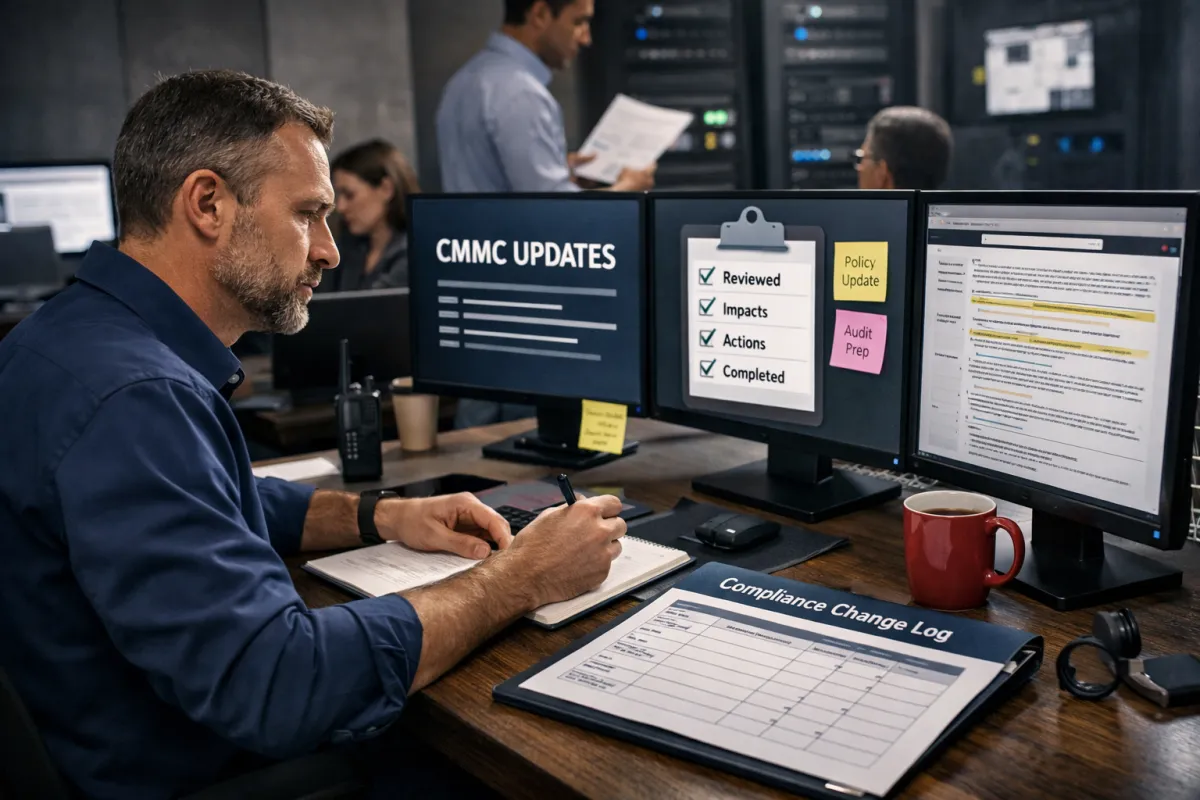
How Contractors Should Monitor CMMC Updates
For many contractors, CMMC compliance feels like a major implementation effort followed by a period of maintenance. Policies are written, technical controls are reviewed, evidence is organized, and teams work toward readiness with the assumption that once the environment is aligned, the primary challenge becomes keeping that structure in place.
That assumption is only partially correct.
Keeping a compliant environment stable is important, but it is not enough on its own. Contractors also need a practical way to monitor what changes around them. Requirements evolve. Guidance is clarified. interpretations shift. Internal environments change. Contract expectations become more specific. Over time, even a well-governed compliance model can become outdated if the organization has no consistent way to detect and respond to change.
This is why monitoring CMMC updates is not just a regulatory awareness activity. It is part of staying compliant.
Organizations that handle this well do not react to every headline or every opinion piece. They also do not ignore updates until assessment pressure forces action. Instead, they establish a repeatable process for identifying relevant changes, reviewing what they mean, determining whether internal policies or controls are affected, and documenting what was done in response.
That is what mature compliance monitoring looks like.
Why Monitoring Matters Even in Stable Environments
A common mistake in compliance programs is assuming that stability in the internal environment means stability in the compliance landscape.
In practice, those are two different things.
An organization may maintain consistent access reviews, log monitoring, vulnerability management, and evidence collection while still falling behind in areas such as:
updated expectations tied to evolving guidance
revised internal interpretations of scope or accountability
policy language that no longer reflects current requirements
evidence practices that no longer match what reviewers or assessors are focusing on
changes in business operations that affect how controls should be applied
This is where many contractors become vulnerable. Their controls are still operating, but their compliance model is no longer fully aligned to the current environment.
Monitoring updates helps prevent that gap from growing quietly over time.
What “CMMC Updates” Actually Includes
When people hear the phrase CMMC updates, they often think only about major rule changes or formal announcements.
That is too narrow.
From a contractor’s perspective, updates that can affect compliance often fall into several categories:
1. Regulatory or Program Changes
These are the larger shifts that affect how the CMMC program is structured, interpreted, or enforced.
2. Guidance Clarifications
Even when the underlying framework remains the same, clarifications in language or expectations can influence how organizations understand control execution, evidence, scoping, or accountability.
3. Internal Environment Changes
Not all meaningful updates come from outside the organization. A new application, staffing change, altered approval path, system migration, or operational restructuring can create compliance impact even if no formal external requirement has changed.
4. Assessment Pattern Signals
Organizations also learn from trends that emerge in real readiness and validation environments. If certain weak points repeatedly create friction, that pattern becomes an important source of practical insight.
Contractors that monitor only major external updates usually miss a significant portion of what can affect compliance.
Why Passive Awareness Is Not Enough
Many teams rely on passive awareness to stay current.
They skim a few articles. Someone forwards a webinar link. A compliance lead hears about a change in a meeting. A policy owner makes a note to revisit something later.
This approach creates awareness, but it does not create control.
The problem is not that teams are unaware. The problem is that awareness without structure rarely leads to consistent internal action.
Questions begin to go unanswered:
Was the update reviewed formally?
Did anyone determine whether it affects current controls or policies?
Was ownership assigned for any required changes?
Was the decision documented?
Is there a record of what changed and what the organization did in response?
Without a structured process, updates are remembered unevenly, interpreted inconsistently, and acted on selectively.
That is where compliance begins to drift.
What Mature Contractors Do Instead
Organizations with mature compliance governance do not rely on passive awareness. They use a defined internal process to monitor change.
That process usually includes five core steps.
Step 1: Identify the Change
The first step is simply to capture that something potentially relevant has changed.
This may come from:
formal announcements
compliance briefings
legal or contractual review
internal governance meetings
operational changes in the environment
repeated patterns observed in readiness or assessment preparation work
The important point is not just seeing the change. It is recording it.
Step 2: Determine Relevance
Not every update requires action.
Some changes are informational. Others may be relevant only to certain environments, levels, or contract situations. Mature organizations do not overreact to every development. They assess whether the change actually affects:
policy language
role assignments
review cadence
evidence expectations
control implementation
governance structure
This step prevents both neglect and unnecessary churn.
Step 3: Assign Review Ownership
If a change may have internal impact, someone must be responsible for evaluating it.
That responsibility should be role-based and clear.
Without assigned ownership, updates often stall in discussion rather than moving into action.
Step 4: Document the Decision
Whether the decision is:
no action needed
policy update needed
control review needed
evidence model update needed
leadership visibility needed
it should be documented.
This is what creates traceability and helps explain why certain changes were addressed or not addressed.
Step 5: Follow Through Operationally
The final step is implementation.
If a change affects ownership, review cadence, policy structure, evidence expectations, or workflow, the organization should update the relevant process and ensure the change is reflected in actual operations.
This is where compliance monitoring becomes governance rather than awareness.
What a Practical Monitoring Process Looks Like
A mature monitoring process does not have to be complicated.
In many environments, it can begin with a simple governance workflow:
identify change
log the update
determine internal relevance
assign owner for review
document impact decision
track implementation if action is needed
The key is consistency.
This is where a Compliance Change Log becomes useful. It gives the organization a structured way to record:
what changed
when it was identified
who reviewed it
whether it affects current compliance posture
what action was taken
when the action was completed
That turns vague awareness into operational accountability.
Where Monitoring Usually Breaks Down
Even organizations with strong readiness work often struggle with monitoring because of several predictable issues.
Ownership Is Undefined
Teams may assume the compliance lead, security lead, or IT manager is watching for updates, but no one role is clearly accountable for evaluating changes end to end.
Internal Changes Are Not Treated as Compliance Events
Organizations often monitor external developments more carefully than internal operational changes. But staffing changes, workflow shifts, and new systems can affect compliance just as much.
Decisions Are Made but Not Logged
A team may review a change and even decide what to do, but if there is no record of that decision, the organization loses continuity and repeatability.
Updates Are Reviewed but Not Operationalized
Sometimes the change is recognized, but policies, review cadence, or workflows are never updated. This leaves the organization with awareness but no actual alignment.
Monitoring CMMC Updates Is Really About Managing Change
At its core, monitoring updates is a change management discipline.
The issue is not simply whether something new happened. The issue is whether the organization has a reliable way to decide:
does this affect us?
what needs to change?
who owns it?
how do we document it?
how do we know the response actually happened?
That is why this topic belongs inside governance, not just compliance awareness.
Organizations that handle change well stay aligned without constant rebuild effort. Organizations that handle change informally often create a growing disconnect between current expectations and current operations.
A Practical Example
Consider a contractor that has a strong access review process documented in policy and consistently executed across the environment.
Over time, the environment changes. A new application is introduced, responsibilities shift, and one team begins handling approvals differently than before.
No one thinks of this as a compliance change. It is treated as an operational adjustment.
Months later, the organization discovers that access review documentation no longer reflects the full workflow, and approval responsibilities in policy no longer match the actual process.
Nothing changed from a formal regulatory standpoint. But the compliance model is now out of alignment because internal operational change was never captured or reviewed through a governance lens.
A structured update monitoring process would have caught that earlier.
What Contractors Should Be Looking For
When monitoring updates, contractors should focus on the practical question:
Does this change affect how we govern, execute, or evidence our controls?
That includes reviewing whether the update has implications for:
ownership and accountability
review cadence
policy language
evidence retention
escalation paths
workflow documentation
system scope or role responsibilities
This is what makes monitoring useful. It connects change to action.
Why This Reduces Compliance Fatigue
Organizations that do not track change systematically often end up in a cycle of rediscovery.
The same issues are revisited repeatedly because no structured record exists of what changed, what was reviewed, and what was decided.
That creates unnecessary effort.
A defined monitoring process reduces fatigue because it creates continuity. Teams do not need to guess whether something was reviewed or whether action was already taken. They can see it.
This makes compliance more manageable and less reactive.
Conclusion
Contractors should not monitor CMMC updates by trying to absorb every external development or react to every new interpretation.
They should monitor updates by building a structured internal process for identifying relevant changes, reviewing their impact, assigning accountability, documenting decisions, and updating governance where needed.
That is what allows compliance to remain aligned as requirements, expectations, and operations evolve.
Mature organizations understand that staying compliant is not only about sustaining controls. It is also about sustaining the ability to respond to change without confusion, overreaction, or drift.
The organizations that do this well are not just better informed.
They are better governed.
CTA
To help organizations track and respond to compliance-related changes in a structured way, we created a practical resource:
Compliance Change Log Template
This template helps document updates, assign review ownership, track internal impact, and record what action was taken so compliance changes are not handled informally or forgotten over time.
Download the template to create a more structured way to monitor change and maintain alignment as CMMC expectations evolve.


