Lessons Learned From Recent CMMC Assessment Trends
One of the most useful ways to improve a compliance program is to pay attention to patterns.
Not isolated events. Not one-off internal issues. Patterns.
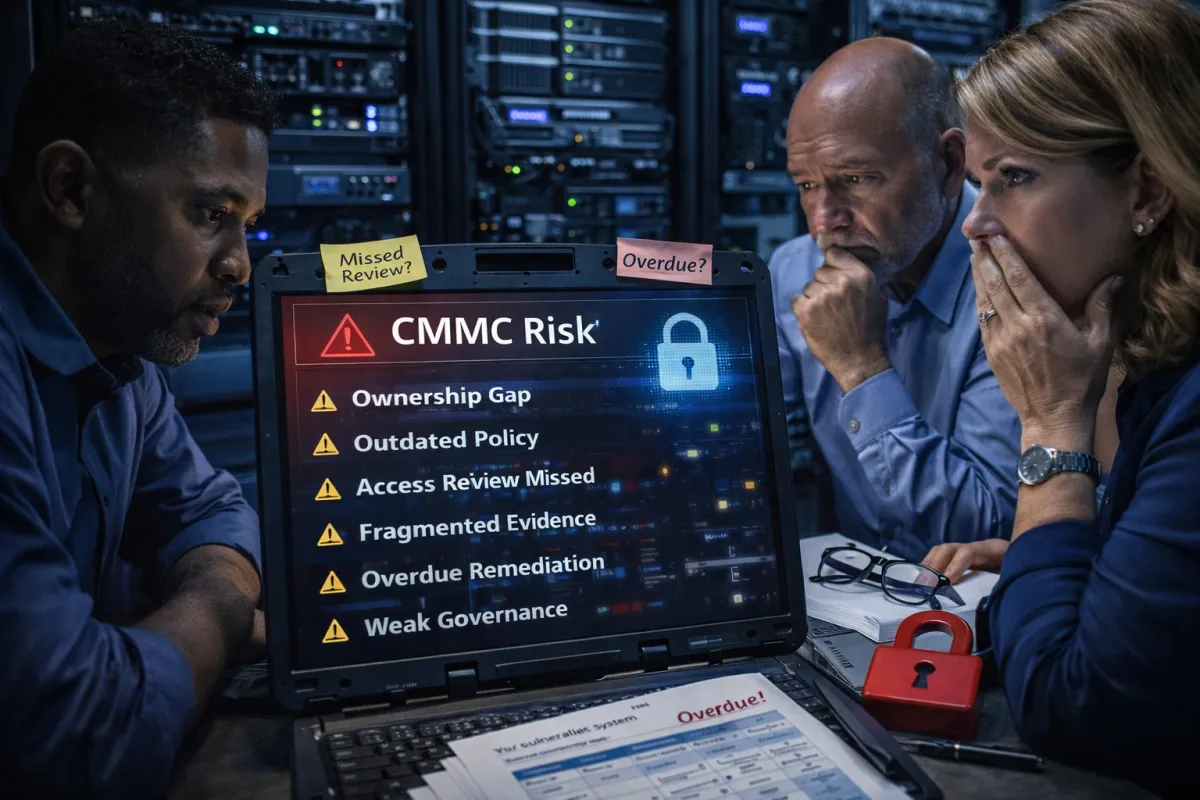
Across CMMC readiness work, certain themes continue to surface. Organizations may differ in size, industry, technical stack, or maturity level, but the same underlying weak points often reappear:
ownership is unclear
evidence exists but is fragmented
review cadence is expected but inconsistently enforced
policy language no longer reflects actual practice
teams assume compliance is stronger than it really is
These are not abstract concerns. They are the recurring patterns that create friction when environments are reviewed more closely.
The value in watching recent assessment trends is not simply knowing what others struggled with. It is using those signals to identify where your own environment may already be vulnerable.
That is where the real lesson is.
Trend 1: Controls Often Exist, but Governance Around Them Is Weak
A recurring pattern is that many organizations do not struggle because a control is completely absent.
They struggle because the governance around the control is not strong enough to make it sustainable.
For example:
access controls are in place, but review ownership is informal
logs are collected, but review cadence is not clearly documented
vulnerability scanning occurs, but remediation accountability is inconsistent
change approvals happen, but evidence retention varies by team
From a high level, these controls may appear present.
Under closer review, the weakness is not technical implementation. It is operational structure.
This is why organizations that focus only on whether a control exists often overestimate their readiness.
The real question is whether the control is governed consistently enough to be explained, evidenced, and defended over time.
Trend 2: Evidence Quality Matters More Than Evidence Volume
Another common pattern is the assumption that more evidence automatically creates stronger readiness.
It does not.
Many organizations collect large amounts of evidence but still struggle because the evidence is:
stored across too many locations
disconnected from the control it is meant to support
inconsistent across teams
hard to retrieve quickly
incomplete in showing recurring activity over time
This creates unnecessary friction.
Recent assessment patterns continue to reinforce that evidence must be:
relevant
attributable
timely
consistent
aligned to the control and workflow being described
Evidence quality is a governance outcome, not just a document management issue.
Trend 3: Ownership Gaps Create Disproportionate Risk
Ownership remains one of the most common weak points in Level 2 environments.
This is especially true in environments where readiness preparation was driven by a temporary effort rather than transitioned into a durable operating model.
Common patterns include:
primary owners are assumed but not documented
backup ownership is missing
ownership of recurring review differs from ownership of implementation
escalation authority is unclear
staff can describe the technical control but not who owns the process around it
These gaps often do not seem serious until accountability is tested.
At that point, the lack of structure becomes visible very quickly.
This is one reason why governance maturity often determines whether otherwise solid environments feel stable or fragile.
Trend 4: Policy Drift Is More Common Than Many Teams Realize
Recent trends also continue to reinforce how often policies drift away from operations.
During readiness preparation, documentation is often reviewed carefully. But after implementation, environments continue to evolve while policies remain unchanged.
This leads to:
review responsibilities that no longer match current roles
approval workflows that no longer follow documented policy
evidence expectations that no longer reflect actual practice
procedures that describe an earlier version of the environment
Teams may still believe the policy is current because it was reviewed relatively recently.
But if it no longer reflects how work is done, it becomes harder to rely on as a governance tool.
This is one of the clearest signs that a program has not fully transitioned from project mode to governance mode.
Trend 5: Recurring Activities Are Where Programs Usually Drift
Many recurring readiness issues show up in areas that depend on routine execution rather than one-time implementation.
Examples include:
quarterly access reviews
monthly remediation tracking
periodic policy review
recurring evidence validation
regular change approval oversight
scheduled log review
These activities usually begin with good intent.
The issue is sustaining them.
Recent trends continue to show that organizations often perform these activities for a period of time, then gradually allow cadence to weaken as operational pressure increases.
Once cadence slips, evidence becomes less consistent, and control defensibility becomes harder to maintain.
This is why recurring activities should be treated as governance functions rather than optional administrative tasks.
Trend 6: Internal Confidence Is Often Higher Than Operational Reality
Another common lesson is that many teams believe their environment is more aligned than it actually is.
That is understandable. Internal teams know the systems, understand the work, and often feel that controls are being handled responsibly.
But internal familiarity can hide drift.
When ownership is informal, when evidence is reconstructed, or when policies are only partially aligned to real workflows, those issues may not be obvious to people working inside the environment every day.
This is one reason external perspective is useful.
The goal is not to create fear. It is to surface the difference between confidence and consistency before assessment pressure makes that difference more expensive.
What Mature Organizations Learn From These Trends
Mature organizations do not use assessment trends as abstract observations.
They use them diagnostically.
They ask:
Do we have similar ownership assumptions?
Is our evidence as consistent as we think it is?
Have our policies kept pace with operational change?
Are our recurring activities documented well enough to show continuity?
Are we overestimating readiness because the controls seem familiar internally?
These are the kinds of questions that help translate general trends into practical governance improvement.
That is what makes assessment trends useful.
A Practical Example
A contractor may believe its remediation process is solid because vulnerability scans are performed regularly and tickets are created when issues are found.
That appears strong on the surface.
But if no one has clearly documented:
who prioritizes remediation
how overdue issues are escalated
what evidence confirms closure
where decisions about exceptions are retained
then the environment may already reflect several of the trends described above.
The problem is not a missing scan.
It is a weak governance model around the activity.
This is exactly why looking at recurring patterns matters more than looking at single tasks in isolation.
What Contractors Should Take Away
The most useful lesson from recent assessment trends is not that organizations are struggling in unusual ways.
It is that the same issues appear repeatedly because governance weaknesses are common, and they tend to stay hidden until closer scrutiny occurs.
That means contractors should focus less on whether they have already “done the work” and more on whether the structure around that work is stable enough to survive time, change, and review.
That includes:
ownership
cadence
evidence continuity
policy alignment
change management
These are the areas that consistently separate temporary readiness from durable readiness.
Conclusion
Recent assessment trends continue to point to the same reality: technical implementation matters, but governance determines whether compliance holds up.
Organizations rarely struggle because they never touched the control. They struggle because the structure needed to sustain it was never fully established, documented, or maintained.
That is the lesson worth paying attention to.
The strongest organizations are not the ones that wait for assessment to reveal weak points. They use recurring patterns to identify where their own program may already need attention.
That is how lessons learned become practical advantage.
CTA
To help organizations track changes, decisions, and internal follow-through in a more structured way, we created a practical resource:
Compliance Change Log Template
This template helps document what changed, who reviewed it, whether internal action is required, and how the response is tracked through completion.
Download the template to strengthen how your organization responds to evolving expectations and recurring compliance risks.


